

Table of Contents
- Why Dry Skin Needs a Different Kind of Skincare
- Key Ingredients to Look for in the Best Natural Skincare for Dry Skin
- How to Choose an Organic Moisturizer for Dry Skin
- Natural Remedies for Dry Skin You Can Try at Home
- Building a Non-Toxic Skincare Routine for Dry Skin
- DIY vs. Professional Products: What Delivers Better Results?
- Sustainability and Packaging: The Impact of Your Skincare Choices
- Frequently Asked Questions
Last Updated: September 12, 2026
Why Dry Skin Needs a Different Kind of Skincare
Dry skin is not simply skin that lacks water; it is skin whose barrier has stopped holding moisture in. That distinction shapes everything about how you treat it. The best natural skincare for dry skin works with your barrier rather than against it.
Most people treat dryness by adding more water. That approach fails. Water evaporates, and if the barrier is compromised, it evaporates faster than you can replace it. The fix is lipid support: oils, butters, and fatty acids that seal moisture into the skin and give the barrier the raw material it needs to rebuild.
The Difference Between Dry and Dehydrated Skin
Dry skin lacks oil. Dehydrated skin lacks water. They feel similar, but they need different responses. Dry skin often feels rough and tight, while dehydrated skin can feel tight yet still produce shine. Many people have both at once, which is why a single lightweight lotion rarely solves the problem. You need a routine that addresses oil and water at the same time.
How the Skin Barrier Loses Moisture
The skin barrier is the outermost layer of skin, made of lipids and skin cells that lock in moisture and keep irritants out. When that lipid barrier thins, water escapes through a process called transepidermal water loss. Harsh cleansers, cold weather, and synthetic fragrances all accelerate that loss. Once the barrier is weakened, skin becomes reactive, flakey, and prone to inflammation.
American Academy of Dermatology guidance on dry skin care
Key Ingredients to Look for in the Best Natural Skincare for Dry Skin
The best natural skincare for dry skin pairs three ingredient types: humectants that pull water in, emollients that soften, and occlusives that seal. Miss one and the formula underperforms.
Humectants, Occlusives, and Emollients Explained
Humectants are ingredients that attract and hold water in the skin. Glycerin is the most reliable, and it is backed by decades of use. Emollients fill the gaps between skin cells to make skin feel smooth. Occlusives form a seal on top to slow water loss. Cold-pressed oils often do double duty.
| Ingredient Type | What It Does | Natural Examples |
|---|---|---|
| Humectant | Pulls water into skin | Glycerin, aloe, honey |
| Emollient | Softens and smooths | Jojoba, shea butter, squalane |
| Occlusive | Seals in moisture | Beeswax, plant waxes, heavy oils |
Plant-Based Botanicals and Antioxidants That Soothe
Botanicals like colloidal oatmeal calm inflammation and support the lipid barrier. Antioxidants such as vitamin E and green tea extract protect against environmental stress that worsens dullness and fine lines. Niacinamide, a form of vitamin B3, supports the barrier and evens skin texture. Look for these alongside essential fatty acids from cold-pressed oils.
How to Choose an Organic Moisturizer for Dry Skin
An organic moisturizer for dry skin should list its humectants, emollients, and occlusives clearly, carry a recognized organic certification, and avoid synthetic fragrance. If the label hides behind vague claims, walk away.
Reading Labels: What Organic Certification Actually Means
Organic certification means a third-party body verified the ingredients and farming methods against a published standard. It is not the same as "natural," which has no legal definition in skincare. When a product claims organic status, check which certifier signed off and what percentage of ingredients qualifies.
Ingredients to Avoid: Synthetic Fragrances and Harsh Chemicals
Synthetic fragrances are among the most common triggers of irritation in sensitive skin. Parabens, phthalates, and sulfates strip the barrier and can worsen inflammation. If you have reacted badly to conventional products before, start by eliminating fragrance entirely. Non-comedogenic formulas matter too, especially if you are prone to breakouts alongside dryness.
FDA information on cosmetics and ingredient labeling
Natural Remedies for Dry Skin You Can Try at Home
Home remedies work best when you understand why they work. Most kitchen treatments for dry skin fall into one of two jobs: pulling water into the skin (humectant action) or sealing water in (occlusive action). A remedy that only does one job will underperform a remedy that does both, which is the single biggest reason people try an oatmeal bath, feel soft for an hour, and then feel tight again by evening.
Here is how the dependable options actually function, and how to sequence them.
Colloidal oatmeal: humectant plus barrier support
Colloidal oatmeal is finely milled oat that stays suspended in water. It contains beta-glucans and avenanthramides, which are the compounds studied for calming irritation and supporting the lipid barrier. The practical version: draw a lukewarm bath, add roughly one cup of colloidal oatmeal (not instant breakfast oats, which are too coarse to suspend), and soak for 10 to 15 minutes. Pat, do not rub, dry, then apply moisturizer within about a minute. The soak hydrates; the moisturizer seals. Skip the seal and you have simply wet your skin.
Honey masks: a humectant with mild antibacterial activity
Raw honey is a humectant that also holds a low water activity, which is why it has long been used on minor irritation. Apply a thin layer to clean skin, leave 10 minutes, and rinse with lukewarm water. Honey alone does not seal, so follow it with an oil or balm. If your skin is reactive, patch-test on the jawline first, honey is gentle but not universally tolerated.
Oil massage: the occlusive half of the equation
Cold-pressed jojoba, sweet almond, and avocado oils are the workhorses here. Jojoba is technically a wax ester that closely resembles human sebum, so it absorbs without a heavy film. Sweet almond is lighter and higher in oleic acid. Avocado is heavier and better for very dry, flaky patches. Press a few drops into damp skin before bed, applying oil to bone-dry skin traps almost nothing, because there is no water underneath it to hold in.
Humidifier: the cheapest intervention nobody measures
Indoor humidity in heated homes commonly drops well below the 30 to 50 percent range that most dermatology guidance treats as comfortable for skin. Running a humidifier overnight reduces the gradient that drives water out of your skin, which means your moisturizer has less work to do. Clean the reservoir regularly, a dirty humidifier aerosolizes mold, which is worse than dry air.
The layering rule that makes all of them work
Order matters more than the individual remedy. The sequence is: hydrate (oatmeal soak, honey, or a glycerin serum) → seal (oil, butter, or balm) → protect (humidifier, lukewarm water, no harsh cleanser afterward). Keep water lukewarm throughout. Hot water strips the lipids your barrier just rebuilt, which is why a long hot shower can undo a good routine in ten minutes.
A realistic weekly pattern
- Daily: lukewarm cleanse, hydrate on damp skin, seal with oil or balm.
- Two to three times per week: colloidal oatmeal soak, followed immediately by moisturizer.
- As needed: honey mask on irritated patches, oil massage before bed.
- Every night: humidifier in the bedroom during heating season.
If a remedy stings, burns, or leaves skin tighter after it dries, it is the wrong remedy for your barrier right now, stop it and simplify.
Building a Non-Toxic Skincare Routine for Dry Skin
A non-toxic skincare routine for dry skin needs three steps, not ten. Cleanse gently, hydrate, and seal. That is the entire framework, and it works better than a crowded shelf of products.
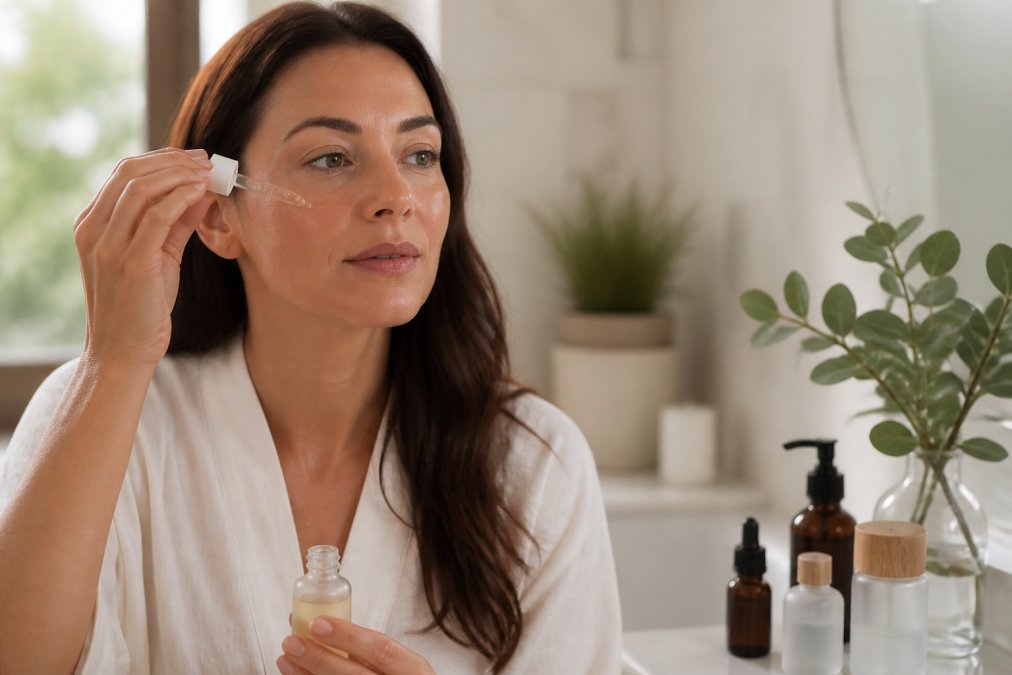
A Simple Three-Step Routine for Busy Days
- Cleanse: use a cream or oil cleanser with lukewarm water. Skip foaming formulas.
- Hydrate: apply a glycerin or niacinamide serum to damp skin.
- Seal: finish with a plant-based moisturizer or facial oil.
That is it.
DIY vs. Professional Products: What Delivers Better Results?
This is the question most articles dodge, because the honest answer is not "DIY is better" or "buy the product", it is that the two solve different problems, and the cost math changes depending on which problem you have. Here is a straight cost-benefit breakdown.
What DIY genuinely does well
A colloidal oatmeal soak, a honey mask, and a bottle of cold-pressed jojoba cost very little per use and give you total control over what touches your skin. For an acute flare-up, a windburned face, a winter eczema patch, a reaction to a new cleanser, a kitchen remedy is often the fastest, cheapest way to calm things down. There is no preservative system to react to, no fragrance, and no waiting for shipping. For barrier soothing, DIY is hard to beat on cost per treatment.
Where DIY quietly fails
Three things are genuinely difficult to do in a kitchen:
- Stability. Oils and water-based mixtures oxidize. A homemade lotion made with water and no preservative can grow bacteria within days, which is why most food-safety guidance treats unpreserved water-based cosmetics as a short-lived, refrigerated product. Anhydrous (water-free) DIY, straight oils, balms, butters, is far safer because there is no water for microbes to grow in.
- Concentration control. You cannot reliably hit a target percentage of niacinamide or a specific humectant-to-occlusive ratio by eyeballing. Formulated products are made to a spec.
- Texture and comedogenicity. Getting a moisturizer that absorbs, does not pill under makeup, and does not clog pores is a formulation problem, not a mixing problem.
The cost-benefit math
Think in terms of cost per effective treatment, not cost per bottle.
- DIY oils and balms: very low cost per use, high control, but limited to soothing and sealing. They do not deliver actives like niacinamide or stabilized antioxidants.
- Formulated moisturizers and serums: higher upfront cost, but you are paying for tested concentrations, preservative systems, and consistent texture. For anti-aging goals, softening fine lines, supporting elasticity, this is where the money actually buys a result.
- The hybrid approach most practitioners recommend: use DIY for soothing and cost control, and reserve formulated products for the steps where concentration and stability matter (serums, treatment moisturizers).
A simple decision rule
| Your goal | Better fit |
|---|---|
| Calm an acute flare-up fast and cheaply | DIY (oatmeal, honey, plain oil) |
| Seal moisture on a daily basis | Either, a single oil or a simple balm works |
| Target fine lines, dullness, or uneven texture | Formulated product with tested actives |
| Sensitive, reactive skin | Fragrance-free formulated product, or plain anhydrous DIY |
The takeaway
DIY wins on cost and control for soothing. Formulated products win on stability, concentration, and consistency for results. The mistake is treating it as an either/or. Most people get the best return by spending on the two or three formulated steps that actually need precision, and handling everything else with a cheap, well-understood kitchen remedy.
Sustainability and Packaging: The Impact of Your Skincare Choices
Packaging is where most "clean" brands quietly fall short. The skincare industry generates substantial plastic waste, and much of it is never recycled. Choosing refillable or minimal-plastic formats is one of the highest-impact decisions you can make, and it does not require giving up results.
At WildBloom Skincare, we formulate in small batches and use minimal plastic packaging to reduce that footprint.
EPA data on municipal solid waste and packaging
Dry skin rarely improves from a single product. It improves when your routine supports the lipid barrier consistently, with the right humectants, emollients, and occlusives working together. WildBloom Skincare builds small-batch, plant-based formulas without synthetic fragrance, parabens, or phthalates, designed for sensitive skin and simple routines. Our cruelty-free, vegan products are made for people who want visible results without a ten-step regimen. Shop WildBloom Skincare.
Frequently Asked Questions
What is the best natural thing to put on dry skin?
Cold-pressed plant oils rich in essential fatty acids, like jojoba, rosehip, and argan oil, are among the best natural options for dry skin. They mimic skin's natural lipids to support the lipid barrier and reduce transepidermal water loss. Colloidal oatmeal and glycerin are also effective humectants that draw moisture into the skin. Look for non-comedogenic, dermatologist-tested formulas free from synthetic fragrances to avoid irritation on sensitive skin.
What is the best natural moisturizer for extremely dry skin?
For extremely dry skin, choose an organic moisturizer for dry skin that combines humectants like glycerin with occlusives such as shea butter or squalane. These ingredients work together to pull water into the skin and seal it in. Niacinamide supports the skin barrier and improves skin elasticity over time. Apply while skin is still damp after cleansing to lock in hydration and reduce flakey skin.
How can I hydrate my skin naturally without chemicals?
A non-toxic skincare routine for dry skin starts with a gentle, sulfate-free cleanser, followed by a humectant-rich serum and a nourishing moisturizer. Avoid synthetic fragrances, parabens, and phthalates that can strip the skin barrier. Natural remedies for dry skin, like aloe vera gel and honey masks, add extra hydration. Drinking enough water and using a humidifier also support skin hydration from the inside out.
What ingredients should I avoid in natural skincare for dry skin?
Skip products with synthetic fragrances, parabens, phthalates, and harsh sulfates, which can trigger inflammation and weaken the skin barrier. Alcohol-based toners and exfoliants with large particles also worsen dehydrated skin. Instead, look for plant-based formulas with botanicals, antioxidants, and cold-pressed oils. Check for organic certification and hypoallergenic labels to confirm the product is suitable for sensitive skin.