

Table of Contents
- What Makes a Plant Based Anti Aging Cream Actually Work
- Natural Retinol Alternatives: Peptides, Bakuchiol, and Plant Stem Cells
- How to Choose Plant-Based Skincare for Fine Lines and Wrinkles
- Ingredient Synergy and Contraindications in Plant-Based Formulas
- Building a Clean Beauty Anti-Aging Routine for Morning and Evening
- Budget-Friendly vs. Luxury Plant-Based Creams: What the Price Difference Actually Buys
- Beyond the Bottle: Two Factors Most Guides Skip
- Conclusion
- Frequently Asked Questions
Last Updated: September 12, 2026
What Makes a Plant Based Anti Aging Cream Actually Work
A plant based anti aging cream works when its botanical actives support the skin's own repair systems rather than masking damage. Most formulas fail because they rely on one hero ingredient instead of addressing barrier repair, hydration, and cell turnover together.
The best plant based anti aging cream earns its results through concentration, sourcing, and how well its actives work together.
Botanical Actives That Support Skin Elasticity and Barrier Repair
Skin elasticity is the skin's ability to stretch and snap back, and it depends on collagen and elastin fibers that degrade with age and sun exposure (peer-reviewed research). Botanical actives can support this process measurably.
The most studied plant-derived options include:
- Antioxidants such as vitamin C from kakadu plum and green tea polyphenols, which neutralize environmental stressors before they break down collagen
- Essential fatty acids from rosehip and sea buckthorn, which reinforce the skin barrier and reduce moisture loss
- Soothing botanicals like centella asiatica and chamomile, which calm irritation that accelerates visible signs of aging
A strong plant based anti aging cream pairs these with humectants, typically glycerin or hyaluronic acid, to hold water in the skin while the barrier repairs itself.
Natural Retinol Alternatives: Peptides, Bakuchiol, and Plant Stem Cells
Natural retinol alternatives encourage cell turnover and collagen production without retinol's irritation. The three most credible options are peptides, bakuchiol, and plant stem cells, but they do not work the same way, and treating them as interchangeable wastes money.
Peptides are short chains of amino acids that act as signaling molecules, telling fibroblasts, the cells that manufacture collagen and elastin, to ramp up production. Different sequences send different signals, so a formula listing "peptide blend" without naming them is hard to evaluate. Look for named sequences such as copper tripeptide-1, palmitoyl tripeptide-1, or matrixyl, ideally before the preservative block.
Bakuchiol, derived from the seeds of the babchi plant (Psoralea corylifolia), is the most studied botanical retinol alternative (PubMed). It influences some of the same gene-expression pathways retinol does, supporting cell turnover and improving the look of fine lines, without the same photostability or irritation profile. That is why it can be worn during the day and layered with vitamin C, which retinol generally cannot.
Plant stem cells, usually from apples, edelweiss, or grape, do not become stem cells in your skin. They are extracts that protect existing cells from oxidative and UV stress, supportive and preventive, not transformative, a distinction most marketing copy blurs.
How These Alternatives Compare to Synthetic Retinol
Synthetic retinol remains the most studied anti-aging ingredient, and it works. The trade-off is tolerability. Many people experience peeling, redness, and sun sensitivity, especially in the first weeks, and the adjustment period can last a month or longer (PubMed).
Plant-based alternatives trade some raw potency for consistency. You can use them daily, in the morning, and alongside other actives without the same irritation risk, usually a worthwhile trade for sensitive skin or anyone with a history of reactions to conventional formulas.
| Ingredient | Primary Action | Irritation Risk | Best For |
|---|---|---|---|
| Peptides | Signals collagen production | Low | Sensitive, reactive skin |
| Bakuchiol | Supports cell turnover | Low | Retinol-intolerant users |
| Plant stem cells | Protects against stressors | Very low | Prevention, early aging |
| Synthetic retinol | Accelerates cell turnover | High | Tolerant skin, stubborn lines |
How to Read Clinical Claims Without a Science Degree
When a brand cites "clinically proven," the useful questions are simple:
- How many people, and for how long? A 12-week study with 40 participants carries more weight than a 2-week study with 12. Small, short studies are common in cosmetics and simply weaker evidence.
- Was there a control group? If everyone used the product and everyone improved, you cannot tell how much was the cream versus the moisturizer base, the season, or regression to the mean.
- Was it blinded? Participants who know they are testing a "miracle" botanical rate their own skin more favorably. Blinded designs reduce that bias.
- What was actually measured? Instrumental measurements (corneometry for hydration, cutometry for elasticity, image analysis for wrinkle depth) are more objective than self-reported satisfaction scores.
- Who paid for it? Brand-funded studies are not automatically invalid, but they are a reason to look for independent replication.
A practical shortcut: if a brand publishes participant numbers, duration, and measurement method, that transparency is itself a quality signal. If the only claim is "clinically proven" with no numbers, assume the evidence is thin.
How to Choose Plant-Based Skincare for Fine Lines and Wrinkles
Choosing plant-based skincare for fine lines and wrinkles comes down to reading the ingredient list before the front label. "Natural" and "botanical" are not regulated, so the back of the bottle is the only reliable source.
Start with these filters:
- Actives near the top: Peptides, bakuchiol, and antioxidants should appear in the first half of the list, not after fragrance and preservatives
- No synthetic fragrance: "Fragrance" and "parfum" are common irritants; look for essential-oil-free or naturally scented formulas
- Non-comedogenic oils: Jojoba, squalane, and rosehip absorb without clogging pores
- Cruelty-free and vegan claims: Meaningful only when paired with a transparent ingredient list
Reading Labels: What to Look For and What to Avoid
What to look for: recognizable plant oils, named actives with concentrations where stated, and short lists you can actually pronounce.
What to avoid: parabens, phthalates, synthetic fragrance, and vague "proprietary blend" language that hides what's actually inside.
Ingredient Synergy and Contraindications in Plant-Based Formulas
Ingredient synergy is where most plant-based formulas either shine or fail: some actives amplify each other, while others cancel out or cause irritation when combined.
Good pairings:
- Vitamin C + vitamin E: These antioxidants regenerate each other, improving stability and effectiveness
- Hyaluronic acid + ceramides: One pulls water in, the other seals it, so hydration lasts longer
- Bakuchiol + peptides: Gentle turnover plus collagen signaling, without the irritation of retinol
Pairings to approach carefully:
- Retinol with strong acids: Increased irritation and barrier damage
- Vitamin C with benzoyl peroxide: The two can oxidize each other
- Multiple exfoliating acids in one routine: Over-exfoliation strips the barrier
The practical rule: introduce one active at a time, give your skin two weeks, then add the next.
Building a Clean Beauty Anti-Aging Routine for Morning and Evening
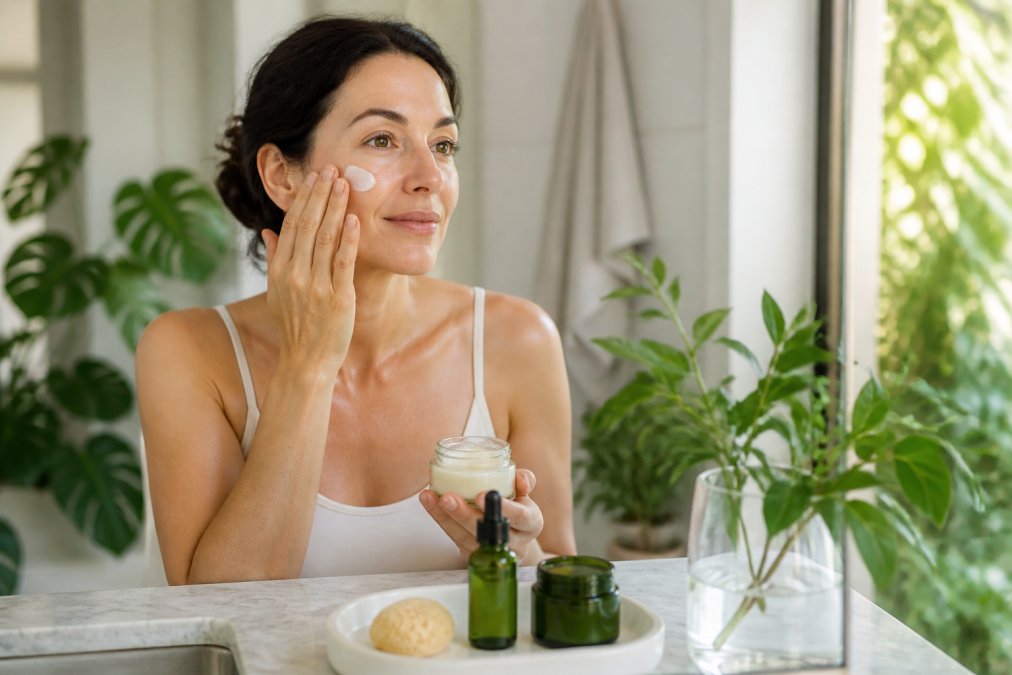
A clean beauty anti-aging routine doesn't need ten steps. It needs the right three or four, used consistently, morning and night.
The core sequence is simple: cleanse, treat, moisturize, protect. Everything else is optional.
Morning Routine: Protection and Hydration
Mornings are about defense. Your skin faces UV exposure, pollution, and temperature shifts all day.
- Gentle cleanse to remove overnight buildup without stripping
- Antioxidant serum to neutralize environmental stressors
- Moisturizer with hyaluronic acid or ceramides for hydration
- SPF 30 or higher every single day, rain or shine
Sunscreen is the single most effective anti-aging step you can take. No serum outperforms daily sun protection.
Evening Routine: Repair and Regeneration
Evenings are for repair. Cell turnover peaks overnight, so this is when actives do their best work.
- Double cleanse if you wore sunscreen or makeup
- Peptide or bakuchiol treatment to support collagen and turnover
- Richer moisturizer or facial oil to seal in hydration
- Eye cream if fine lines around the eyes are a concern
Budget-Friendly vs. Luxury Plant-Based Creams: What the Price Difference Actually Buys
The price gap between budget and luxury plant-based creams buys three things: active concentration, sourcing quality, and formulation stability. It does not guarantee better results, judge a cream by the cost per use of the actives that actually matter, not the number on the jar.
What Higher Prices Actually Fund
- Active concentration. A peptide at 0.5% is a label claim; the same peptide at 3% is a formula. Brands rarely disclose percentages, but ingredient order is a clue: if the hero botanical appears after fragrance and preservatives, it is likely present at a fraction of a percent.
- Sourcing quality. Bakuchiol from babchi seeds grown and processed under controlled conditions is more consistent than commodity supply. Cold-pressed oils retain more antioxidants than solvent-extracted versions, a difference that shows up over months, not days.
- Formulation stability. Plant actives, especially vitamin C, bakuchiol, and unsaturated oils, oxidize. Pricier formulas often invest in better packaging (airless pumps, opaque glass, UV-blocking components) and preservation systems. A cheap cream in a clear, wide-mouth jar may degrade before you finish it.
What You Often Do Not Get
Packaging prestige, a signature scent, and a celebrity endorsement are not anti-aging ingredients. Some mid-range formulas outperform luxury ones because they spend on actives instead of marketing, while a low-cost cream is a false economy if the active is underdosed or oxidizes within weeks.
A Cost-Per-Use Framework
Instead of comparing sticker prices, compare the cost per use of the actives you care about.
- Divide the price by the number of uses. A 1.7 oz jar used twice daily typically lasts about 8 to 10 weeks. A $60 cream and a $120 cream may differ by only a few dollars per week.
- Check the active's position on the panel. If the peptide or bakuchiol sits below the preservative, you are paying mostly for the base, regardless of price.
- Factor in packaging. An airless pump preserves actives longer than an open jar, which means more of what you paid for reaches your skin.
- Consider the routine cost. A single well-formulated cream that replaces a serum, a moisturizer, and an eye cream can be cheaper per month than three budget products that each do less.
Price correlates with quality up to a point, then diverges into branding. Read the ingredient list, check disclosed concentrations, and judge the formula on its merits, not the shelf it sits on.
Beyond the Bottle: Two Factors Most Guides Skip
Two things separate a plant based anti aging cream that works from one that sits unused: how its actives interact, and how the ingredients were sourced and produced.
A formula built around one trendy botanical rarely outperforms one where peptides, antioxidants, and barrier lipids are balanced to support each other. Look for that balance rather than a single headline ingredient.
Extraction method matters too. Cold-pressed oils retain more nutrients than solvent-extracted versions, and small-batch production shortens the time between harvest and bottling, affecting both potency and footprint. If sustainability drives your choice, ask brands how botanicals are sourced, not just whether they're organic.
Conclusion
Choosing the best plant based anti aging cream means looking past the label and evaluating what's actually inside: proven actives at meaningful concentrations, a formula that supports barrier repair, and a routine you'll actually follow. That's the standard WildBloom Skincare builds to, with non-toxic, vegan formulas made in small batches, free of synthetic fragrance, parabens, and phthalates, and designed for every skin type. Start with a simple cleanse, treat, moisturize, and protect routine, and give it a few weeks. Shop WildBloom Skincare to find plant-based formulas made for real, visible results.
Frequently Asked Questions
Do plant-based anti-aging creams work as well as retinol?
Plant-based creams with natural retinol alternatives like bakuchiol and peptides can improve fine lines and skin texture without the irritation often caused by synthetic retinol. Research shows bakuchiol delivers similar anti-aging benefits to retinol but with less redness and peeling. However, synthetic retinol still has more long-term clinical data. For sensitive skin or those who cannot tolerate retinol, plant-based options are a strong choice. Results typically appear within four to twelve weeks with consistent use.
What ingredients should I look for in a vegan anti-aging moisturizer?
Look for peptides to support collagen production, hyaluronic acid for hydration, antioxidants like vitamin C from botanical sources, and bakuchiol as a retinol alternative. Niacinamide helps with skin texture and barrier repair. Avoid synthetic fragrance, parabens, and phthalates if you have sensitive skin. Non-comedogenic formulas are important for acne-prone skin.
Are plant-based skincare products better for sensitive skin?
Plant-based products often contain fewer synthetic irritants, making them gentler for sensitive skin. Ingredients like aloe, chamomile, and oat extract soothe redness and support the skin barrier. However, natural does not automatically mean non-irritating. Some botanical extracts, like citrus oils, can cause reactions. Patch-test new products and introduce one at a time. Look for formulas with short ingredient lists to reduce risk.
How do I build a clean, anti-aging skincare routine?
Start with a gentle cleanser, then apply an antioxidant-rich serum in the morning followed by a plant-based moisturizer and SPF. In the evening, cleanse, apply a treatment cream with peptides or bakuchiol, and finish with a barrier-repair moisturizer. Three to four products are enough. Consistency matters more than complexity. Introduce active ingredients gradually and always patch-test. A simple routine you follow daily outperforms a ten-step routine you skip.